03 / 03 GPU compute
WebGPU Compute Pipeline
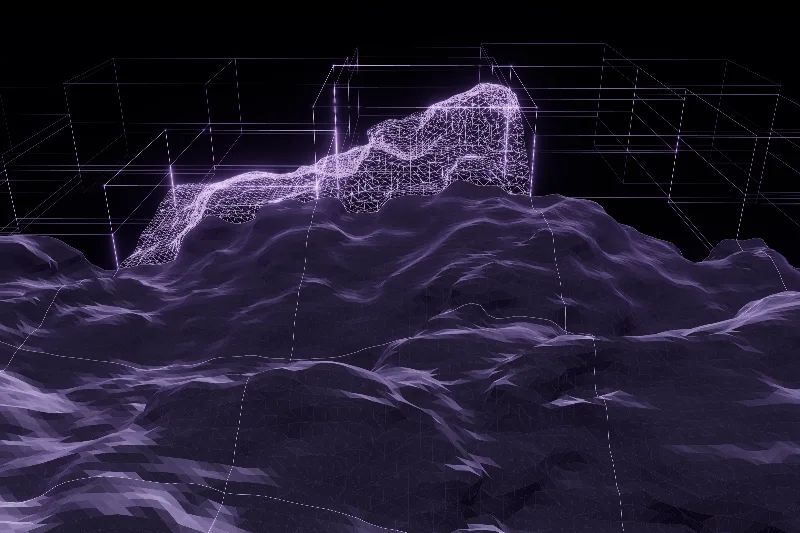
A browser-based procedural generation engine. Perlin noise and Marching Cubes run entirely in WebGPU compute shaders, so infinite terrain streams in without geometry ever crossing back to the CPU.
01 Results
Generates 64×64×64 voxel chunks in < 2 ms, entirely on the GPU. Zero CPU–GPU memory stalling.
- Voxels per chunk
- 64³
- Per chunk, GPU only
- < 2 ms
- CPU–GPU memory stalls
- 0
02 Problem
Procedural terrain on the web usually meshes on the CPU — often in WASM — and uploads the result. Every chunk pays for the copy across the bus, blocks a thread while it builds, and caps how fast new ground can appear. Meanwhile the GPU sits idle, waiting for geometry it could have produced itself.
03 Architecture
The CPU decides what to build; the GPU samples, meshes and draws it. Nothing is ever read back.
-
01
Chunk scheduler
C++ in WASM streams chunks around the camera by distance and visibility.
-
02
Density pass
fBm Perlin noise evaluated per voxel into a 3D storage texture.
-
03
Classify & compact
A Marching Cubes case per cell; a prefix sum packs only the cells that emit triangles.
-
04
Mesh pass
Vertices and gradient normals written straight into a pooled GPU vertex buffer.
-
05
Indirect draw
Vertex counts written on the GPU feed drawIndirect. No readback, no stall.
04 Engineering
- 01
Zero readback
The CPU never learns how many triangles a chunk produced. The mesh pass writes the count into an indirect-arguments buffer and the render pass consumes it with drawIndirect — noise to pixels without a single mapAsync.
- 02
Stream compaction, not atomics
Most cells in a chunk are empty. A workgroup-level exclusive scan over per-cell vertex counts gives each non-empty cell its write offset, instead of every thread contending on one global atomic counter.
- 03
Seamless by construction
Each chunk samples a one-voxel apron of its neighbours’ density. Shared faces produce identical vertices and normals, so chunks never crack and never have to talk to each other.
- 04
C++ where the logic branches
Scheduling, LOD selection and culling are branchy and cache-sensitive, so they run as C++ compiled to WebAssembly and hand the GPU a compact list of chunk jobs each frame.
05 Excerpt
@group(0) @binding(0) var<uniform> chunk : Chunk;@group(0) @binding(1) var density : texture_storage_3d<r32float, write>; // One invocation per density sample: the chunk's cells plus a one-voxel// apron, so neighbouring chunks agree on every shared vertex.@compute @workgroup_size(4, 4, 4)fn sampleDensity(@builtin(global_invocation_id) id : vec3u) { if (any(id >= chunk.samples)) { return; } let p = chunk.origin + vec3f(id) * chunk.voxel; var d = -p.y * chunk.ground; // half-space: solid below the ground plane var amplitude = 1.0; var frequency = chunk.frequency; for (var octave = 0u; octave < 6u; octave++) { d += perlin3(p * frequency) * amplitude; // fBm over 3D Perlin noise amplitude *= 0.5; frequency *= 2.0; } textureStore(density, id, vec4f(d, 0.0, 0.0, 0.0));}The density texture never leaves the GPU: the classify, scan and mesh passes read it in place.

06 Specification
- API
- WebGPU compute and render, one command encoder per frame
- Chunks
- 64 × 64 × 64 voxels, generated in < 2 ms on the GPU
- Kernels
- WGSL, 4×4×4 workgroups
- Meshing
- Marching Cubes with prefix-sum stream compaction
- Draw path
- drawIndirect, zero CPU readback
- Host
- C++20 compiled to WebAssembly
- Memory
- Pooled vertex slots, no allocation while streaming